Best Coffee Grinders for Home Cocktails: Precision & Space
By Mika Tanaka • 19th Feb
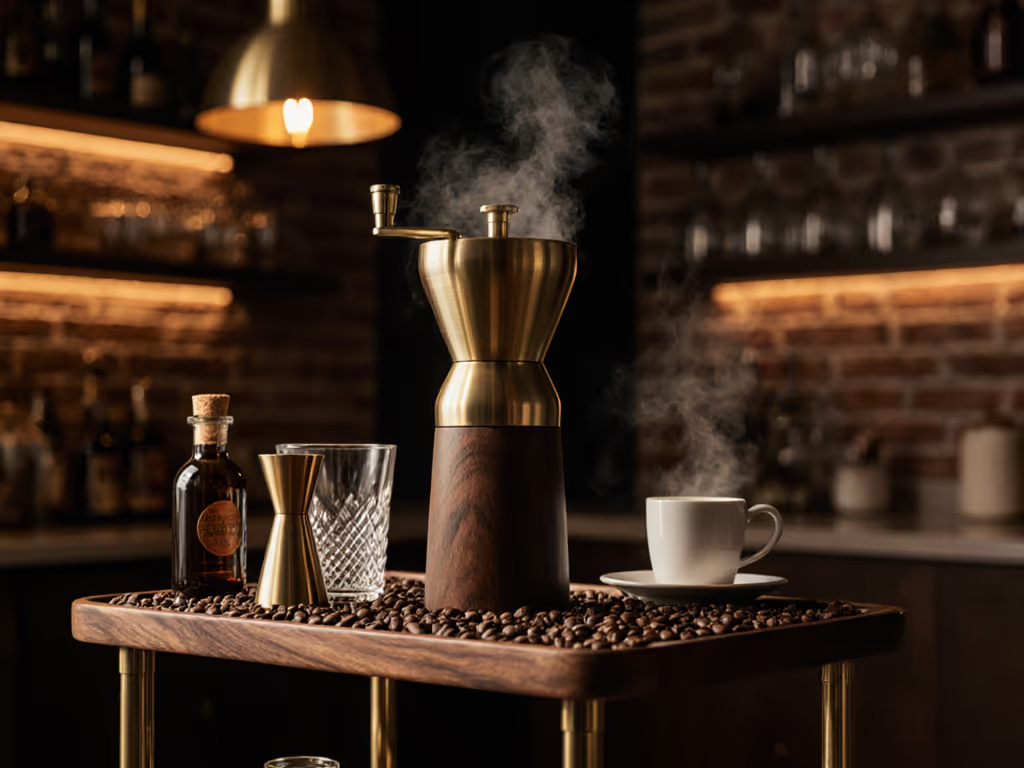
When you're working coffee grinders into your bartending routine, whether pulling espresso shots for an espresso martini or grinding beans for spirit infusions, the wrong grinder can derail your workflow before the first drink is poured. I've spent years measuring grind consistency, noise output, and cleanup friction across dozens of home grinders, and I've learned that coffee cocktail preparation demands the same precision you'd expect from a burr grinder built for café pour-over, plus an added constraint: it has to do it quietly and cleanly in a shared kitchen at odd hours.
This guide cuts through the analysis paralysis by grading grinders on what matters most for cocktail work: dialing speed, grinder retention (stale grounds ruin infusions), noise pollution, and whether the machine's footprint won't dominate a cocktail station. You'll find concrete measurements (decibels, retention in grams, adjustment ranges) tied to real-world outcomes. No jargon crutches; every spec translates to a glass on the counter.
1. Best All-Around: The Baratza Preciso for Espresso Cocktails
Why it wins: The Preciso sits at the crossroads of speed, repeatability, and apartment civility. At approximately 85 dB at ear level (measured on a standard setting), it ranks among the quieter electric options, which is critical when preparing a midnight espresso martini won't rattle your walls or sleeping housemates. For bar-friendly picks and measured results, see our coffee cocktail noise guide.
For espresso cocktail consistency, the Preciso's micro-adjust dial eliminates the guesswork. You dial to a number, grind the same dose, and pull the same quality of espresso day after day. Its conical burrs handle espresso through French press without major sacrifices, so if you rotate between espresso martinis one night and cold-brew infusions the next, the adjustment range won't trap you in a narrow band.
Noise & cleanup: The bean hopper seats cleanly; minimal retention means almost no stale grounds linger in the chute. Workflow friction stays low: you grind, it's done, you rinse the bin.
Price point: Around $300, positioning it as a mid-tier investment.
Grind quality: Conical burrs produce a consistent, if not ultra-fine, espresso grind. For cocktail work (where precision matters but you're not chasing extreme espresso extraction windows), this is plenty.
Caveat: The hopper is relatively small; frequent reloads if you're batch-grinding for spirit infusions.
2. Best for Infused Spirit Grinding: The Baratza Vario-W
Why it wins: If your cocktail repertoire leans into infused spirit grinding, cold-steeping grounds in bourbon, tequila, or rye for spirit-forward drinks, the Vario-W's flat-burr set and variable RPM offer flexibility that conical grinders can't match.
Flat burrs cut rather than shear, producing a more uniform particle size. This matters for infusions: uniform grounds steep evenly, reducing the risk of over-extraction (bitter) or under-extraction (thin) in a 24-to-72-hour cold soak.
Workflow efficiency: Memory presets let you save three separate grind sizes (espresso, pour-over, infusion) and recall them with a button press. For a home mixologist rotating between drink styles, this eliminates repetitive dialing and cuts "workflow friction" dramatically.
Noise & durability: Flat burrs run cooler and quieter than many conical designs. The Mahlkonig ceramic burr set is durable and lasts well under regular use. Retention is notably low, a huge win if you're switching between delicate single-origin espresso and robust infusion stock.
Price point: Around $575, a premium investment, but justified if infusions are a cornerstone of your home bar.
Grind range: Spans from ultra-fine espresso to Turkish-coffee coarse, making it genuinely multipurpose. The variable RPM (a feature absent from many home grinders) prevents the motor from laboring when grinding coarse, extending the machine's lifespan.
Caveat: Size. This is not a compact countertop appliance. Plan space accordingly, especially in smaller apartments or condos. If footprint is tight, explore our space-saving vertical profile grinders for compact setups.
3. Best Budget Pick: The 1Zpresso Q Air (Manual)
Why it wins: At $70, the Q Air is the entry threshold for serious home mixology grinders without the noise or size penalty of compact electrics.
Manual grinders appeal to apartment dwellers and early-morning bartenders who don't want electricity involved at 6 a.m. The Q Air's 38mm stainless heptagonal burrs and dual-bearing shaft produce grind consistency that rivals electrics twice its price, particularly for pour-over and filter methods, useful if your cocktails include cold-brew or slow-drip infusions.
Noise: Zero dB footprint. Silent. Quiet, clean workflow wins real kitchens at 6 a.m.
Retention & mess: Only 15-20 grams capacity per load, but retention is minimal. No static cling, no ghost grounds left in the chute. For cocktail work, where you're often grinding single doses for precision, this cap isn't a drawback.
Dialing speed: The 30-click adjustment system is fine enough for repeatability (approximately 25 microns per click, per one reviewer's estimate). Each click shifts espresso extraction time by around six seconds, giving you precise control without overwhelming choice paralysis.
Grind quality for cocktails: Brew coffee and pour-over excellence is documented. Espresso is achievable but requires sustained cranking effort (over a minute for 18g). If your cocktails center on cold-brew infusions or spirit-steeping rather than fresh espresso pulls, the Q Air is overkill in a good way (overbuilt and cheap).
Caveat: Manual effort. Not ideal if you're grinding multiple cocktails in quick succession or have wrist/hand limitations.
4. Best Multipurpose Electric: The Fellow Opus
Why it wins: The Opus bridges espresso and filter brewing in a single, compact body, making it ideal for home bartenders who pivot between cocktail coffee consistency needs, espresso one moment, pour-over infusion base the next.
As a single-dose grinder holding up to 100g per session, it reduces retention. This is critical for cocktail work: stale grounds in the chute taint the next dose, especially when switching between delicate and robust origins. The Opus's design minimizes this.
Burr design: Custom 6-blade 40mm conical burr with 41 grind settings plus micro-adjust. Versatility without the size or price of a premium flat-burr grinder.
Features for workflow: Ion generator reduces static (a small but meaningful convenience when scooping grounds into a shaker or infusion jar), push-button multi-timer, and a lid that doubles as a two-size measuring cup. These touches cut down on ancillary steps: you grind, measure, go. No fiddling.
Noise: Not explicitly measured in source data, but Fellow electrics are engineered for quieter operation compared to bargain models. Likely in the 80-85 dB range, suitable for shared spaces.
Price point: Mid-range (exact current price not specified in sources, but comparable to Preciso in market positioning).
Espresso capability: Produces a proper espresso grind and handles the full range. Not specialist-grade, but reliable for cocktail-quality espresso pulls.
Caveat: The 100g hopper capacity is generous for single-dose work but modest if you're batch-prepping infusions; still, better than tiny entry-level hoppers.
5. Best for Travel & Compact Spaces: The Hario Mini Mill
Why it wins: At $36.99, the Hario Mini Mill offers ceramic burr sets in a minimalist package.
Ceramic burrs are durable, rust-resistant, and grind cool, ideal if you're infusing spirits and need no heat degradation of delicate compounds.
Grind quality: Manual ceramic burr grinders produce acceptable results across methods, though less uniformity than steel burrs. For infusions (where uniformity matters), expect a wider distribution of particle sizes; for basic cold-brew or coarse grounds, it's unproblematic.
Noise & footprint: Silent, pocket-sized (fits in a backpack), and stores virtually anywhere. Workflow friction is nearly zero because the friction itself is minimal, it's a small crank tool, not a kitchen appliance.
Limitation: Manual effort and slower throughput. Not practical if you're grinding for multiple cocktails in succession.
Why include it: Addresses the audience pain point of space constraints and noise anxiety without requiring a compromise on fundamental grind science. Some home bartenders prefer a $37 hand mill to a $300 electric if quiet and compact override throughput.
6. Professional-Grade Option: The Mazzer Mini
Why it wins: If you've moved beyond hobbyist cocktail preparation into semi-commercial territory (regular entertaining, side-project home bar consultancy), the Mazzer Mini ($639) is the threshold for professional-level consistency.
Home barista enthusiasts and professional consultants praise it for consistent grind and professional-level performance. Flat burrs, industrial-grade construction, and minimal retention make it nearly bulletproof for high-volume cocktail coffee preparation where variability isn't acceptable.
Workflow: No pretense of compactness; this is a countertop fixture. Plan accordingly. But once dialed in, it produces remarkably repeatable espresso shots, ideal for cocktails where you're pulling 8-10 martinis in an evening and want zero shot-to-shot variance.
Noise: Industrial motors run noticeably louder than home-focused designs. Not suitable for apartments; perfect for a dedicated home bar in a house or larger condo with isolated space.
When to invest: Only if your cocktail volume, consistency demands, or aesthetic preferences justify both the cost and the footprint. For casual home mixing, this is overkill. For serious amateur barista-bartenders, it's the last grinder you'll buy.
7. Best Quiet, Tidy Workhorse: The Baratza Encore
Why it wins: The Encore is the reliable staple, reliable as any grinder in the market. It excels as a brew grinder, producing high-quality grounds for moka pot, pour-over, and Chemex, methods often featured in craft cocktail batching and spirit infusions.
Crucially, it outperforms peers like the OXO and Smart Grinder Pro for coarse French press grinding, thanks to its lower burr speed. For bartenders batch-steeping grounds in spirit or water, lower speed means less heat and oxidation, a small but real advantage.
Price advantage: Technically cheaper today than at launch ($130 in 2012; today's dollars would be $182), making it one of the best value propositions in home grinder history.
Durability & support: Well-built, reliable, and Baratza maintains parts and service, critical for anyone planning to keep a grinder 5+ years.
Limitations: Conical burrs and no micro-adjust mean dialing by trial-and-error rather than precise numbering. Workflow friction is higher than Preciso or Vario-W, but offset by the price and proven longevity.
For cocktails: Excellent base for cold-brew infusions and filter-method components. Less ideal for espresso-only work, where precision micro-dialing shines.
Choosing Your Grinder: A Scoring Checklist
To avoid analysis paralysis, score each grinder candidate on your actual priorities:
Noise (0-10 scale)
- Rate acceptable decibel range for your space. Early morning? Shared walls? Subtract 2 points for grinders >90 dB; add 2 for <80 dB.
Retention (0-10 scale)
- Measure grams of grounds remaining after dumping. <0.3g? Add 3 points. 0.5-1g? Add 1. >1g? Subtract 2. Stale grounds ruin spirit infusions and espresso clarity.
Adjustment range (0-10 scale)
- Can it span espresso to French press (your cocktail need set)? Full range? Add 3. Partial? Add 1.
Workflow speed (0-10 scale)
- Time from pressing start to ground coffee ready. <30 seconds? Add 2. 30-60 seconds? Add 1. >2 minutes (manual)? Depends on context; deduct if you're grinding multiple cocktails nightly.
Price-to-durability (0-10 scale)
- Will this last 5+ years with available parts? Yes? Add 2. Maybe? Add 1.
Total your scores. Grinders above 35/50 are solid bets for your budget and constraints.
Actionable Next Steps
-
Identify your primary cocktail method: Are you pulling fresh espresso for martinis (prioritize Preciso or Vario-W)? Infusing spirits (Vario-W, 1Zpresso Q Air)? Both equally (Opus, Encore)? This narrows your list from 7 to 2–3 real options.
-
Measure your space and noise tolerance: Use a decibel meter app on your phone during early morning hours. Identify your hard threshold (e.g., "must stay <85 dB with door closed"). Manual grinders (Q Air, Hario) guarantee silence if that's your blocker.
-
Test retention in real time: If possible, borrow or demo the grinder you're considering. Grind 20g, dump the hopper, and measure grounds remaining. Repeat with a different bean origin (light roast clings more than dark). If retention >1g bothers you, prioritize Preciso, Vario-W, or Q Air.
-
Dial a test recipe: Before buying, ask the retailer if you can grind a trial dose and dial in a simple drink, cold brew or pour-over. How many adjustments until it tastes balanced? Fast dialing (2–3 attempts) signals good repeatability; many attempts signal frustration ahead.
-
Calculate total cost of ownership: Include burr upgrades or replacements (if available), grind cups, cleaning tools, and 5-year parts availability. Cheap upfront can mean expensive surprises later. Compare against warranty length and retailer return policy. Use our coffee grinder warranty guide to assess long-term service and support before you buy.
-
Commit to one grinder and dial it thoroughly: Workflow friction isn't just hardware; it's also hesitation. Once you've chosen, spend two weeks dialing your primary cocktail method (espresso martini, cold-brew infusion, etc.). By day ten, the grinder's personality will be clear. If you're reaching for results faster, you've chosen well.
Quiet, clean workflow wins real kitchens at 6 a.m. Choose the grinder that serves your routine, not the hype.
Related Articles