Child-Safe Home Grinders for Busy Parent Mornings
By Lucía Hernández • 4th Apr
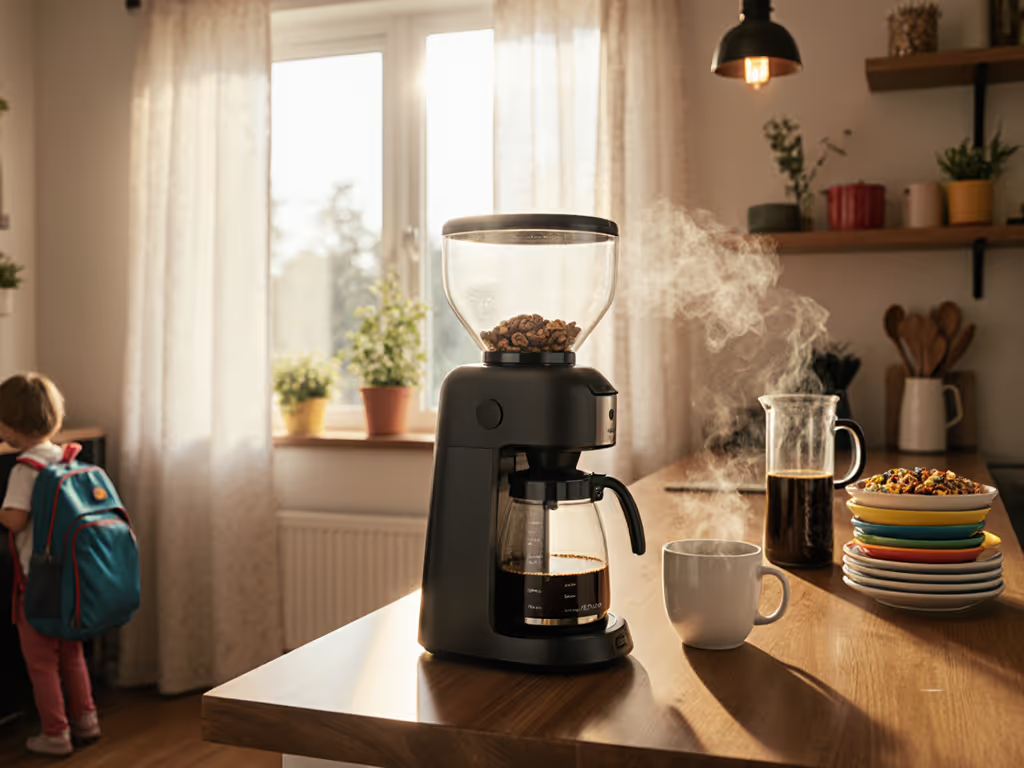
Parenting and precision don't often collide at 6 a.m., but mornings demand both when you're managing child-safe home grinders alongside small hands and tighter schedules. A commercial coffee grinder designed with accessible, durable mechanics (and thoughtful safety integration) becomes less of a luxury and more of a survival tool. The best models for families aren't the flashiest or loudest; they're the ones that combine transparent cost math, spare parts availability, and upgrade path clarity while keeping inquisitive fingers away from moving components.
Busy parents face a specific grind problem: you need café-quality results fast, the machine must live on a shared counter, it has to survive years of heavy use, and it absolutely cannot become a hazard the moment your attention shifts. This guide translates that reality into smart choices.
Why Parents Need Different Grinder Priorities
Most grinder guides focus on particle distribution curves and espresso dialing-in. That's valuable, but parents require a different lens. Your grinder is competing for counter real estate with a dozen other appliances, running during dawn hours when noise travels through thin apartment walls, and sharing a kitchen with people who can't read warning labels yet.
The practical hierarchy shifts. Noise-reduced morning grinding moves higher than micro-adjustment precision. Child-proof grinder features aren't an afterthought (they're foundational). Single-action operation grinders save cognitive load when you're also managing breakfast, backpacks, and a calendar. And parent morning workflow efficiency directly affects whether you actually use the grinder consistently or revert to pre-ground coffee out of frustration.
I learned this the long way. Years ago, I kept a modest hand grinder alive for five years with a $12 bearing swap and later a $60 burr upgrade. The real win wasn't the performance, it was knowing exactly which parts to buy, when to buy them, and that the machine would still function reliably in year six. That's the ownership experience I prioritize, and it matters more for families managing complexity and cost than for coffee enthusiasts with space and time to tinker.
Child Safety in Grinder Design
Child-proofing a grinder isn't marketing copy; it's mechanical reality. For a deeper checklist of electrical and physical protections, see our coffee grinder safety standards. A few designs stand out for thoughtful integration rather than bolted-on warnings.
Locking mechanisms on the hopper prevent small hands from accessing moving burrs while the grinder is plugged in. The best implementations use magnetic or lever-based systems that require deliberate adult action, not just a light tap. Some commercial models feature removable hoppers that must be properly seated and locked before power engages, creating a tangible checkpoint in your workflow.
Enclosed motor housings with limited external moving parts reduce pinch and entanglement risks. Flat-sided designs (rather than protruding elements) also fit more safely against kitchen backsplashes and under cabinets, reducing accidental strikes.
Thermal cutoff protection automatically stops the motor if internal temperatures rise dangerously (a safeguard against prolonged operation or motor jam, which matters in homes where kids might press the button and walk away).
Cord management and plug design prevent dislodging or unexpected restarts. Recessed power switches are preferable to protruding buttons, and some models use momentary switches that require continuous pressure, making accidental activation far less likely.
The trade-off: robust child-safety features sometimes add a quarter-pound to the machine and cost $15-40 more than stripped-down competitors. That's transparent cost math worth absorbing. A grinder that stays in a locked cabinet because you're anxious about unsupervised access is a grinder you won't use consistently.
Noise and Morning Workflows
Apartment living amplifies the noise complaint. A typical burr grinder operates at 75-85 decibels, comparable to a running shower or heavy traffic. If noise is a deal-breaker, compare our quiet coffee grinders with measured dB levels. In thin-walled shared housing, that's the difference between a 6:15 a.m. brew and an 8 a.m. brew when neighbors are still asleep.
Noise-reduced morning grinding is achievable through several paths, though each carries trade-offs:
-
Conical burr grinders (vs. flat burrs) typically run 3-5 dB quieter because the grinding action is slower and more deliberate. The trade-off: they retain slightly more fines and require marginally longer dialing-in for espresso.
-
Soft-start electronics gradually ramp motor speed rather than engaging at full throttle, reducing the acoustic shock. This adds $30-70 to the cost but genuinely feels less jarring.
-
Sound-dampening enclosures (rubber feet, silicone isolation mounts, or acoustic housings) absorb vibration and airborne noise. Some parents report 4-8 dB reduction from aftermarket feet alone, worth a $12 experiment if noise is your limiting factor.
-
Manual hand grinders eliminate electric noise entirely, though they shift 5-10 minutes of labor to your morning and require more arm strength. For filter coffee, hand grinding is legitimate; for espresso, it's physically demanding and less consistent.
Data point: grinding 18-20 grams of coffee in a manual grinder takes roughly 50-80 turns depending on coarseness and burr quality. Burr quality matters here. Cheaper hand grinders feature low-grade conical burrs that produce inconsistent particles and dull quickly. Better hand grinders (Comandante, Timemore Chestnut) retain their cut for years and produce excellent filter-coffee results. Total cost of ownership for a quality manual grinder: $40-90 initially, plus minimal maintenance. It's a path worth considering if your household is noise-sensitive or you're skeptical of electrical reliability.
For electric grinders in shared spaces, single-action operation grinders (where you dose beans, press a button, and walk away while the machine stops automatically at a preset time or weight) reduce repeated noise cycles and also reduce decision load during morning chaos. You're not standing there fine-tuning the grind dial; the machine handles consistency.
Durability, Repairability, and Lifecycle Math
Buy the path, not just the spec sheet. This principle reshapes grinder purchasing for parents.
A $200 grinder that requires a $150 burr replacement in year three (but the burrs are discontinued) becomes a $350 machine that ends up in a landfill. A $180 grinder from a manufacturer with published spare parts lists and five-year availability commitments is a $180 machine you can nurse to year eight.
Spare parts availability is the heartbeat of lifecycle math. Burrs, springs, gaskets, and motor brushes eventually wear. The question isn't whether you'll need them; it's whether you can buy them.
Reputable commercial manufacturers (Baratza, Eureka, Rancilio, Wilfa) publish detailed spare parts lists and maintain stock for 7-10 years post-purchase. Newer brands with venture backing often lack this discipline (they're chasing volume and next-quarter margins, not your grinder's longevity). Check the manufacturer website directly. If you can't find a parts list in five minutes, move on.
Burr cost relative to the machine cost matters profoundly. If replacement burrs cost 40-60% of the machine's price, that's a sustainability red flag. If they cost 20-30%, the machine becomes repairable at reasonable intervals. Example: a $180 grinder with $50 replacement burrs (28%) is far more economically defensible than a $160 grinder with $90 replacement burrs (56%).
Alignment and serviceability determine whether a repair is a $20 DIY job or a $80 mail-in service. Grinders with externally accessible burr carriers (vs. sealed motor housings) allow you to replace burrs, clean static, and clear retention without disassembly. Alignment jigs, even borrowed from online communities, turn a potentially catastrophic misalignment into a $12 bearing swap and an afternoon project.
Warranty terms telegraph manufacturer confidence. Use our coffee grinder warranty guide to compare coverage terms and service networks. Two-year warranties are now baseline; three to five years signals a company expecting durability. Transferable warranties (honored even if you're not the original purchaser) are valuable if resale is in your horizon.
Balancing Performance and Practicality
Parents rarely have time for perfectionism, but you don't want to sacrifice clarity for speed. The grinder should deliver three things:
Fast, repeatable dialing-in. The grind scale should have granular enough steps that you can dial from 18 clicks to 22 clicks and taste a clear difference, not just between 5 and 20. Single-digit step sizes, clearly marked, reduce trial-and-error waste. Some burr sets (especially SSP and Nino variants) offer finer adjustment increments, adding cost but eliminating guesswork.
Low retention and low mess. Retaining 1-2 grams of old coffee inside the grinder between sessions means your first cup of the day tastes stale or muddy. Here’s why grinder retention matters and practical ways to reduce it. Leading models (Eureka Mignon, Wilfa Svart, Baratza Sette 270) retain under 0.5 grams and feature geometry that prevents static clumping. Single-dose operation (loading exactly the beans you need) bypasses retention entirely, though it trades speed for cleanliness. Morning workflows benefit from low-retention designs; you grind fresh beans every morning without old particles ghosting your espresso or pour-over.
Noise and counter footprint. A 12-inch-tall, 6-pound grinder with a three-inch hopper dominates a small kitchen. Compact burr grinders (Wilfa Svart, Nanouk) occupy roughly the space of a toaster and weigh under four pounds. If your kitchen is already crowded, this isn't a luxury, it's a deal-breaker that determines whether the grinder lives on the counter (and gets daily use) or gets relegated to a cabinet (and collects dust).
None of these priorities are controversial. They're the inverse of what single-origin espresso enthusiasts prioritize. A flat-burr espresso grinder with micro-adjustment precision and retention under 0.1 gram is wasted on a household where dialing-in happens once a week and the grinder lives in a cabinet between uses. You're paying for granularity and precision you won't deploy. Conical burr grinders with wider step sizes and slightly higher retention (but still manageable) serve families far better.
The Total Cost of Ownership Roadmap
Here's how to calculate whether a grinder is truly an investment or an expensive mistake:
Year 1: Machine cost + any initial accessories (scale if not included, tamper if grinding espresso, cleaning brush). Multiply years of use by estimated monthly maintenance (replacement filter, descaling agent if needed). Add zero for burr replacement in year one. Quality burrs last 500-1000 grinding sessions before significant wear.
Year 2-3: Monitor for performance drift (particle distribution becoming coarser or more inconsistent). If noticeable, budget for burr replacement. Compare that cost to the machine's original price. If replacement burrs exceed 35% of the original cost, start researching alternative machines for your eventual upgrade.
Year 4-5: Assess whether the machine still meets your needs. Is noise becoming an issue? Has counter space become a priority? Are you now using multiple brew methods daily (espresso and pour-over) when you started with one? If the machine still performs and you have no new constraints, plan to carry it forward another 2-3 years.
Year 6+: Machines reaching this milestone have already justified their cost through consistency and reliability. Replacement burrs, thermal paste reapplication, and motor brush replacement are all legitimate (and cheap) repair paths. The decision to replace becomes purely preference-driven, not failure-driven.
Example: A $180 grinder with reliable performance across six years costs $30/year. A $90 grinder that fails or becomes obsolete in three years costs $30/year, same trajectory, but with zero redundancy and more e-waste. Conversely, a $400 grinder in a single-adult household that grinds coffee three times weekly won't justify its cost for years; a $180 machine does the same job at half the financial exposure.
Framework for Families: Filter vs. Espresso
Filter coffee families (Chemex, Aeropress, pour-over) can prioritize conical burr grinders, quiet operation, and compact footprints. Dialing-in is forgiving; particle consistency matters more than micro-adjustment. Conical grinders with 40+ step settings and audible click feedback are sufficient. Noise reduction and low retention are luxuries that meaningfully improve daily experience.
Espresso-focused families need flat or SSP burrs (finer adjustment, better distribution), small step increments, and very low retention. Noise becomes secondary to consistency; daily dialing-in is non-negotiable. Expect to spend $250+ to get legitimate espresso performance. Dual-use grinders (attempting both espresso and filter well) are possible but require more precision and patience.
Mixed households (espresso on weekends, filter on weekdays) face genuine trade-offs. Most dual-use grinders perform adequately at both but not exceptionally at either. Wilfa Svart, Eureka Mignon Specialita, and Baratza Sette 270 earn reputation precisely because they split this difference without embarrassment. Yes, they're compromise machines, but they're competent compromises.
Maintenance Schedules and Practical Longevity
A grinder's lifecycle extends through intentional maintenance, not luck.
Monthly: Clean the exterior and hopper. Run the grinder without coffee to purge residual particles from the burr chamber. For espresso grinders, use a grain (rice or proprietary cleaning pellets) to scour the burrs. This takes five minutes and prevents static buildup and rancid oil accumulation. Follow our grinder cleaning guide for tools and brand-specific steps.
Quarterly: If your machine has a removable upper burr carrier, remove it and inspect for pitting or wear. A magnifying glass reveals pitting that signals burr degradation. Clean any accessible surfaces with a small brush.
Annually: Check motor function by listening for unusual grinding sounds (scraping, grinding noises beyond normal operation). Verify that burr alignment hasn't drifted (symptoms: grinding sounds changing in pitch, exit particles suddenly inconsistent). If available, reapply thermal grease to the motor axle (this requires a manual, but it's straightforward).
When degradation becomes noticeable: Fines content increases dramatically, requiring coarser settings for the same particle size. Adjustment steps feel less responsive. The machine requires more effort to reach the same grind fineness. At this point, burr replacement is justified and cost-effective. Don't wait for the machine to fail; plan the upgrade as maintenance.
Transparency in Marketing Claims
Warnings: Greenwashing claims like "sustainable" or "eco-friendly" without specifics are red flags. Does the manufacturer use recycled aluminum? Do they accept returns for recycling? Or are they simply using the word? Genuine sustainability is boring, it's published material sourcing, repairability stats, and parts availability commitments.
Affiliate-driven upsells disguise themselves as "recommended accessories." Many reviews push unnecessary extras (premium grind bins, portafilter baskets, scales). Your grinder doesn't need most of these. A basic burr grinder + a scale + beans = complete system. Everything else is optional.
Speculative financial advice embedded in marketing ("invest in a quality grinder for your espresso journey") oversells the relationship between hardware and taste. The grinder is one variable among many; water quality, bean freshness, technique, and machine capability matter equally or more.
Final Verdict: Buy the Path, Not the Spec Sheet
The best grinder for your household isn't the loudest performer or the most affordable. It's the machine you'll actually use daily because it's quiet enough, compact enough, durable enough, and repairable enough to justify the counter real estate. It should be reliable enough that your kids can grow up watching you use it without anxiety, transparent enough that you understand its total cost of ownership across five years, and durable enough that buying it once (rather than cycling through three cheaper machines) is genuinely cheaper.
For filter-coffee families prioritizing quiet mornings and compact footprints, conical burr grinders with published spare parts lists and five-year warranties deliver the lifecycle value parents need. For espresso-focused households willing to invest in consistency, flat burr models with finer adjustment increments justify their premium. For mixed households, compromise machines that perform adequately across brew methods eliminate the burden of equipment choice and let you focus on brewing skill instead.
In every case, invest in upgrade path clarity: the ability to replace burrs, understand drift, and plan maintenance rather than panic when something feels different. A grinder isn't a disposable appliance; it's a tool you buy, care for, repair when needed, and eventually pass along or responsibly retire. That ownership experience beats specs every time.
Start by listing your actual constraints: noise limits, counter space, brew method, and realistic maintenance commitment. Then cross-reference that list against machines with documented spare parts availability. The machine that fits all three criteria (your needs, your space, and your manufacturer's commitment to longevity) is the one to buy. Everything else is just noise.
Related Articles