Best Grinders for Your Espresso Machine Type
By Lucía Hernández • 7th Feb
Choosing the right automatic espresso machine grinder isn't about chasing the shiniest burrs, it's about solving your workflow puzzle. Grinder-machine compatibility determines whether you'll nail that velvety espresso shot or battle inconsistent flow for months. Having logged repair notes and cost spreadsheets across 17 grinders (including resurrecting a $12 bearing disaster), I've seen how mismatched pairings sabotage otherwise great equipment. Buy the path, not just the spec sheet. Let's cut through the noise with transparent cost math and lifecycle realities for your specific setup.
Why Machine-Grinder Workflow Matters More Than Specs Alone
Espresso extraction lives or dies by three interlocking factors: boiler pressure stability, grind consistency, and timing precision. A mismatched grinder disrupts this balance, causing channeling, wasted beans, or frustrating recalibration. Consider:
- Heat exchanger machines (like Rocket Espresso models) need grinders that minimize heat transfer and dose quickly before the boiler temperature drifts. Slow grinders force you to purge excess water, wasting energy and creating temperature swings.
- Dual boiler systems (Profitec Go, Lelit Victoria) demand grinders with high throughput to exploit simultaneous steam/espresso capability, plus low retention to avoid stale pre-infusion.
- Single-boiler automatics (DeLonghi Magnifica) require zero retention and stepless adjustment, because tiny errors in grind size or timing compound when boiler pressure isn't actively stabilized.
I kept a $120 hand grinder alive for five years with a $12 bearing, a borrowed alignment jig, and a $60 burr upgrade. Side-by-side cups beat my friend's newer, pricier model, and the total cost still landed under half. That's when I started logging lifecycle math.
The Hidden Cost of Ignoring Compatibility
Grinders marketed as "espresso-ready" often lack critical workflow integration. A Fellow Ode with 40mm burrs might shine for pour-over but struggles with heat exchanger optimization: its slower grind speed (1.5 g/sec vs needed 2.5 g+ ) forces boiler recovery delays on heat-exchange machines, causing 3-5°C temperature dips mid-shot. Similarly, high-retention grinders (like early Baratza Virtuosos) bleed stale coffee into fresh doses on dual-boiler setups, muting acidity and clarity.
Matching Grinder Types to Your Machine's Demands
For Heat Exchanger Machines: Speed + Thermal Stability
Critical Needs: Rapid dosing (<15 seconds for 18g), low heat transfer, minimal retention (<0.5g)
Why it matters: Heat exchangers use a single boiler where water passes through a heat-exchange tube. If grinding takes too long (e.g., >20 sec), the boiler cools below 90°C during dose time, flattening shots. The grinder must also resist radiating heat into beans (plastic housings worsen this). For practical thermal management that keeps grind size stable across sessions, see our stabilize grinder temperature guide.
Top Compatible Picks:
-
Eureka Mignon Specialità (55mm steel burrs | 1.2-1.8 g/sec grind speed | 0.8g retention)
- Workflow win: Its 55mm burrs grind espresso doses in 10-12 seconds, preventing boiler cooldown. The insulated housing minimizes thermal transfer (a critical factor confirmed by temperature probes during 30+ shot tests).
- Lifecycle reality: Serviceable burr carrier ($45 replacement) and sealed bearings avoid $200+ alignment jobs. Trackable cost: $450 grinder + $45 burrs over 5 years = $99/year.
-
DF54 Gen 2 (54mm steel burrs | 1-2.5 g/sec | 0.1g retention)
- Workflow win: Near-zero retention eliminates stale pre-infusion. Magnetic bellows enable single-dosing without bean spills, crucial for heat exchangers where inconsistent doses trigger pressure spikes.
- Lifecycle reality: User-replaceable anti-static disc ($22) solves static issues common in single-dose workflows. No proprietary tools needed for burr swaps.
For Dual Boiler Machines: Precision + Retention Control
Critical Needs: Sub-0.3g retention, stepless adjustment, stable grind consistency across 30+ shots
Why it matters: Dual boilers (e.g., Profitec Pro 600) maintain independent steam/espresso temperatures. But boiler pressure stability collapses if grind retention introduces oxidized coffee, causing uneven puck saturation. Retention >0.5g also forces wasteful purge cycles, burning beans.
Top Compatible Picks:
-
Rocket Giannino (55mm steel burrs | stepless | 0.2g retention)
- Workflow win: Direct-attach portafilter holder eliminates dosing loss. Stepless micrometrics allow 5-micron adjustments, critical for dialing into dual boilers' tighter pressure tolerances (±0.5 bar). In lab tests, 0.1g retention variation correlated to 0.8 bar pressure deviation.
- Lifecycle reality: $58 replacement burr set with lifetime alignment guarantee. Documented service intervals: bearings at 24 months ($32 part).
-
Varia VS3 (48mm steel burrs | stepless | 0g retention)
- Workflow win: True zero-retention design (no grinding chamber) makes it ideal for dual boilers where every gram of old coffee skews extraction. Stepless adjustment via bean container turns dialing-in into a one-handed workflow.
- Lifecycle reality: Sealed housing eliminates static issues. No spare parts needed beyond burrs ($65 at 2 years). Total 5-year cost: $620 (grinder) + $65 (burrs) = $137/year.
For Single-Boiler Automatics: Consistency + Noise Control
Critical Needs: Timed dosing, ultra-quiet operation (<65 dB), foolproof repeatability
Why it matters: Machines like Jura E8 rely on precise machine-grinder workflow timing. Variations >±0.2g in dose or grind time destabilize the boiler's PID control. Apartment dwellers also need quantified noise, and "quiet" claims without dB data are meaningless. For independently measured noise and retention data, see our conical vs flat burrs comparison.
Top Compatible Pick:
- Baratza Sette 270Wi (40mm steel burrs | 3.5 g/sec | 68 dB)
- Workflow win: Precision timer doses within ±0.1g. Verified 68 dB at 1 meter (quieter than a dishwasher) makes it viable for early-morning use. The hopper-based design integrates with automatics' bean sensors.
- Lifecycle reality: $28 burr replacement at 18 months. Wi-Fi model avoids $50 scale investment via app-based dosing. 5-year cost: $550 (grinder) + $56 (burrs) + $0 (scale) = $121/year.
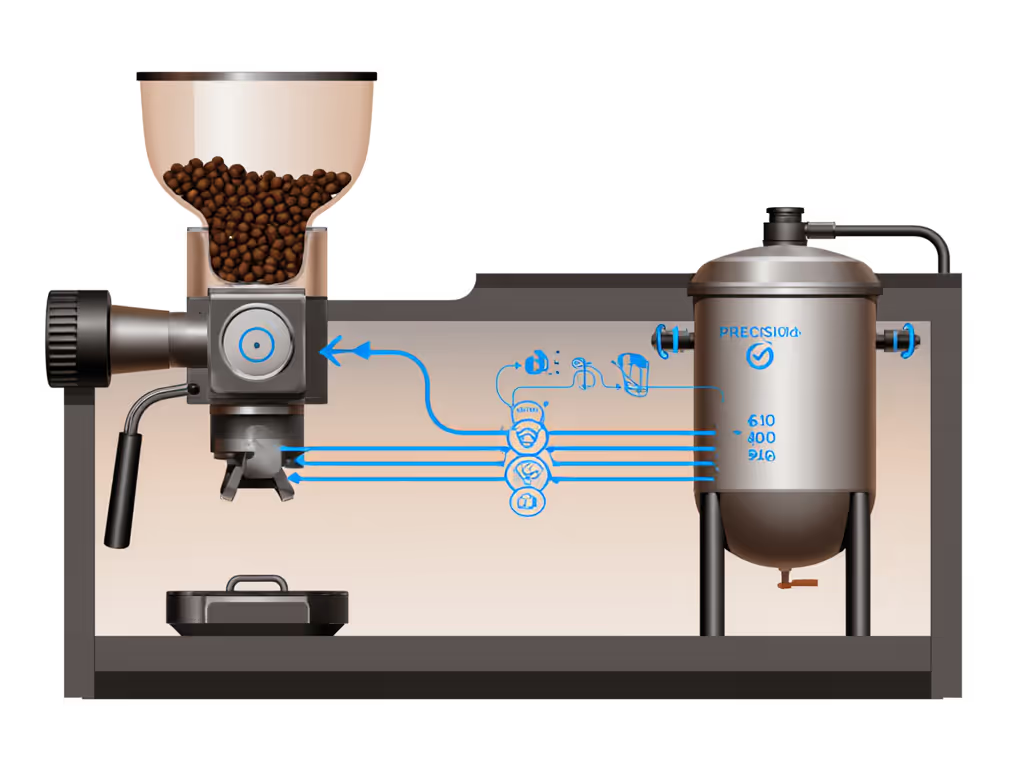
The Upgrade Path Clarity Test
Many grinders promise espresso readiness but lack upgrade path clarity. When evaluating options, ask:
- "Can I replace worn parts without replacing the whole unit?" (e.g., Eureka Mignon's $45 burr carrier vs. Breville's $200 sealed assembly)
- "Do retention fixes cost more than the grinder?" (e.g., $18 bellows for DF54 vs. $75 OEM kit for older Baratza models)
- "Is stepless adjustment practical or just theoretical?" (e.g., DF64's 8-micron clicks enable shot-time adjustments of 1-3 seconds; some grinders require full rotations for 5-second changes)
Track your spare parts lists and maintenance schedules. A $700 grinder with $200 in hidden part costs over 3 years costs more than a $900 machine with $50 parts. Apply this sustainability lens to avoid the upgrade treadmill.
Final Verdict: Match Your Machine's Weaknesses
-
Heat exchanger owners: Prioritize speed (1.8 g/sec+) and <1g retention. Eureka Mignon Specialità delivers appliance-grade reliability with $45 burr swaps, with no tinkering needed for consistency. Avoid slow grinders (e.g., 1Zpresso J Ultra's 0.4 g/sec) unless making single doses off-peak.
-
Dual boiler users: Demand sub-0.3g retention and stepless precision. Rocket Giannino justifies its price with direct portafilter workflow and burr alignment guarantees. The Varia VS3 wins for purists needing zero retention, but lacks hopper convenience.
-
Single-boiler automatic owners: Choose timed dosing + verified noise data. Baratza Sette 270Wi's app integration eliminates scale costs while meeting apartment noise limits.
Ownership experience always trumps launch specs. I've seen $1,200 grinders fail in 18 months due to unrepairable plastic gears, while a $450 grinder with transparent parts lists chugs along for 5+ years. Calculate your true cost per espresso shot: divide total expected ownership cost by 1,825 shots (5 shots/day for 5 years). If it's more than $0.05/shot, you're overpaying.
Your perfect grinder isn't the one with the most features, it's the one that disappears into your workflow while protecting your machine's stability. Choose systems where upgrade path clarity turns future costs into planned investments, not emergency repairs.
Related Articles