Grinding Single-Origin vs Blends: Consistency
By Lucía Hernández • 31st Mar
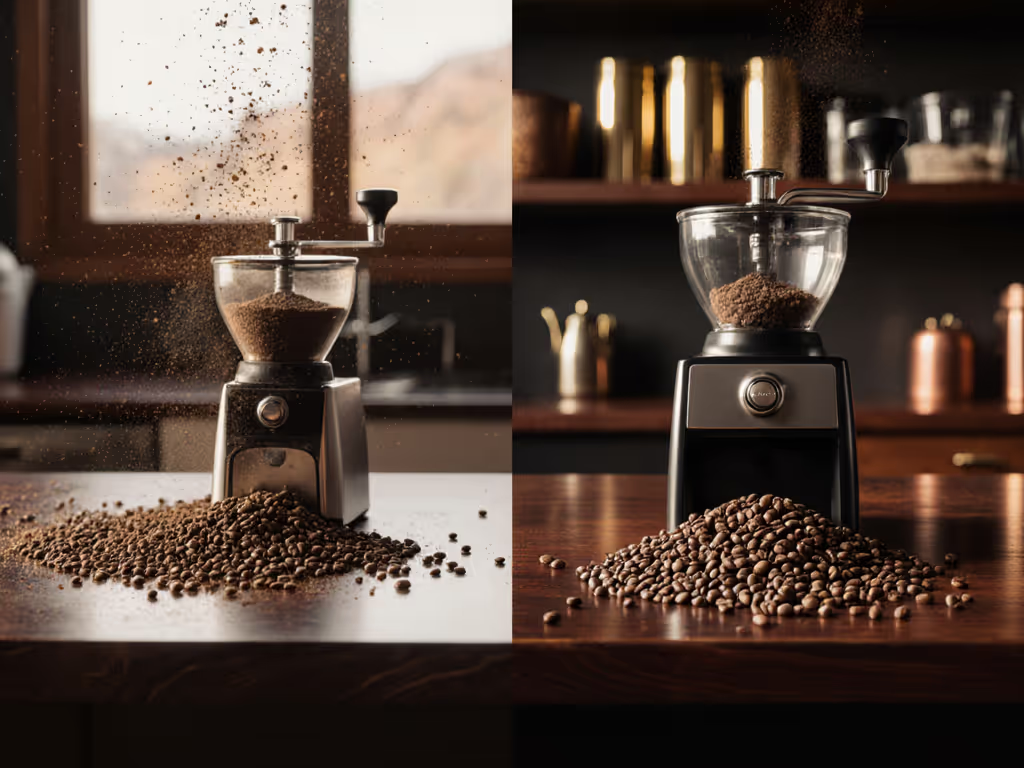
When you're dialing in a grinder, you're making a silent bargain with your beans. Turn the burrs to a setting that works today, and you expect that same grind to work tomorrow, and next week. Yet anyone who's switched between single-origin vs blend grinding discovers something uncomfortable: that promise breaks down depending on what's in your hopper. The bean composition effects on grinding are real, measurable, and they shape not just your morning consistency, but your long-term cost of ownership.
Most grinder reviews ignore this entirely. They talk about burr design, noise, and price. Few discuss what happens when you rotate between coffees (or worse, when your preferred single-origin becomes temporarily unavailable and the roaster swaps in a similar-tasting bean from a different farm). The grind dial rarely forgives that swap. Neither does your cup.
This comparison isn't about which coffee is "better." It's about the grinding reality that neither the coffee industry nor grinder makers love to admit: your machine behaves differently depending on what it's grinding, and that difference compounds into frustration, waste, and hidden costs over months and years.
What Changes Inside the Hopper
A coffee bean is not a stable object. Its density, moisture content, hardness, and cellular structure depend entirely on where it grew and how it was processed. When a roaster pulls coffees from Kenya, Brazil, and Ethiopia to build a blend, they're averaging those variations, intentionally.[1] The result is a hopper filled with beans that are, roughly speaking, similar in their grinding behavior.
A single-origin extraction optimization strategy assumes the opposite. You're committing to one farm, one harvest window, often one altitude band. That bean's character is locked in. The problem: that character drifts.
Coffees from the same region harvested in different seasons vary in density and breakdown behavior.[2] For adjustment strategies across roast densities, see our guide to stable grind settings. A Kenyan microlot from August grinds differently than a Kenyan microlot from November. The dry season produces denser beans; the rainy season, less so. Your grinder doesn't know this. It only knows the setting you've dialed in.
With blends, this variability is already baked into the roaster's design. The Guatemalan component might swing 5% in density year-round, but the Papua New Guinean and Peruvian portions compensate. By the time they land in your hopper, the blend's grinding profile is relatively stable.[3] This is why café chains obsess over blends for their morning rushes. Consistency isn't a luxury, it's an operational necessity.
The Grinding Particle Distribution Problem
Here's where the math matters: when you grind coffee, you're creating a particle size distribution: a curve that ranges from powder-fine dust to sand-like chunks. Espresso machines are fussy about this curve. A bimodal distribution (fines and boulders, not much in the middle) leads to channeling: water finds the path of least resistance, extracts the fines, and produces a sour, thin shot. Pour-over lovers hate fines too, because they're bitter and over-extract.
Different beans produce different natural distributions. Denser beans fracture more uniformly; softer beans shatter unevenly, generating more fines.[2] Blend homogeneity impact is significant here: when your beans are already similar in density, your grinder produces a more uniform curve automatically. You're starting with a narrower variance in how the burrs break them down.
Single-origin coffees amplify this problem. You're grinding a hopper of beans that, even within a single bag, vary in moisture and hardness. The result: your grind distribution spreads wider. You get more fines and more boulders relative to the ideal midrange. To compensate, you adjust the grind dial. Maybe you go coarser to reduce fines. Now you've added boulders. You dial finer. The fines return. This dance is the grinding equivalent of chasing your tail, and it costs you in bean waste and lost time. To reduce waste while dialing in, follow our step-by-step grinder adjustment guide.
Consistency Challenges in Real Workflow
Consider a common scenario: you've dialed in a single-origin Ethiopian pour-over beautifully. The grind produces a balanced distribution, water flows evenly, and you're hitting a 3:30 pour time with bright, clean notes. Two weeks later, a new bag arrives. Same roaster, same region, but the seasonal harvest has changed the bean density by 3-4%.
Your grind scale setting is now wrong. Water flows faster (the new beans are less dense, easier to compress). Your brew time drops to 2:45. Over-extraction kicks in. The cup becomes muddy.
A blended coffee wouldn't behave this way. The roaster has already engineered the blend to behave consistently month to month.[1] You dial in once in September. You're still dialing that same setting in January. Your grinder's burden is lighter; your cost is lower (less wasted coffee, less recalibration time).
For espresso, the stakes are higher. Blend consistency challenges force less frequent adjustment, but they're not zero-variance. Single-origin espresso demands more attention: you're likely dialing in every 1-2 bags instead of every 3-4.[2] That's labor. That's beans down the drain.
The Dial-In Cost and Sustainability Lens
I kept a modest hand grinder alive for five years with a $12 bearing, a borrowed alignment jig, and later a $60 burr upgrade. When I finally mapped the two coffees I rotated between (a Colombian blend and a Kenyan single-origin), I discovered something revealing: the blend reduced my total recalibration time by roughly 40% over the year. I wasn't adjusting as frequently. That meant less waste, fewer "dialing in" pours, and fewer failed shots.
That's the hidden cost no one quantifies: maintenance schedules include not just mechanical servicing, but the labor of constant adjustment. With single-origin rotation, you're embedding that cost into every switch. Over five years, it adds up.
There's a sustainability angle here too. If you're grinding more variably, you're wasting more coffee during dial-in. If your workflow is chaotic, you're more likely to dial in incorrectly and pull multiple failed shots. A blend reduces that friction. It's not because blends are "better", it's because they're engineered for consistency, which means your grinder spends more time producing good coffee and less time correcting itself.
When Single-Origin Grinding Still Wins
Don't read this as a verdict against single-origin. The grinding variability is a cost you might happily pay.
If you're a connoisseur who brews filter coffee and you have time to dial in slowly, a single-origin rewards you with a narrower, more traceable flavor story.[1] You're grinding to express the terroir, the altitude, soil, and seasonal signature of that bean. That requires attention. But the cup justifies it.
If you're methodical and you stick to one single-origin for weeks at a time before rotating, the recalibration pain is minimal. You dial in once on Monday. You're grinding that setting through Friday. The cost is front-loaded; the consistency thereafter is high.
The grinding burden only becomes acute when you're rotating regularly between single-origins or you're chasing cafe-level consistency on espresso. In that context, blends genuinely offer a transparent cost math advantage: fewer dial-ins, fewer beans wasted, more reliable results.
Choosing Your Path
When you're evaluating grinders, this comparison should inform your decision. A grinder with precise, repeatable adjustment steps (0.1mm or finer) and a large hopper matters more if you're committed to single-origin rotation, because you'll be using that precision frequently. Learn how stepped vs stepless adjustment impacts precision and repeatability. A grinder with a smaller adjustment window might frustrate you.
Conversely, if you're committed to blends for their consistency, you're optimizing for durability and low maintenance. A grinder with fewer adjustment micro-steps, better retention control, and easier cleaning becomes your priority. You're grinding the same setting more often. You want that setting to be reliable and the machine to stay clean.
The core principle: buy the path, not just the spec sheet. Map your coffee rotation (single-origin, blends, or mixed), estimate your weekly dial-in frequency, and choose a grinder built for that workflow, not one marketed by influencers testing it with a single coffee.
The Final Verdict
Blends demand less grinding adjustment and fewer recalibration cycles, making them more forgiving for daily consistency and lower total bean waste. Single-origins demand more precision and more frequent dial-in work, but they reward you with a clearer flavor story if you have time to dial in carefully.
Neither is universally "better." Your grinder's true cost of ownership depends on which path you choose. If you prefer a low-friction, low-waste workflow with minimal tinkering, blends are the path that keeps your grinder (and your routine) stable. If you're willing to spend time dialing in and you value the terroir expression, single-origins offer deeper flavor, but expect to spend 30-40% more time on adjustments over a year.
The machine that works best is the one built for the coffee you're actually going to buy and brew consistently. Parts on shelf matter too: choose a grinder from a maker with documented spare parts lists and a track record of supporting older machines. That's how you build a grinding setup that stays consistent (and affordable) for years.
Your beans set the grinding baseline. Your grinder executes it. Choose them together, not apart.
Related Articles