Commercial Grinder: Dialing In for Coffee Terroir Profiles
By Elena Petrescu • 10th Dec
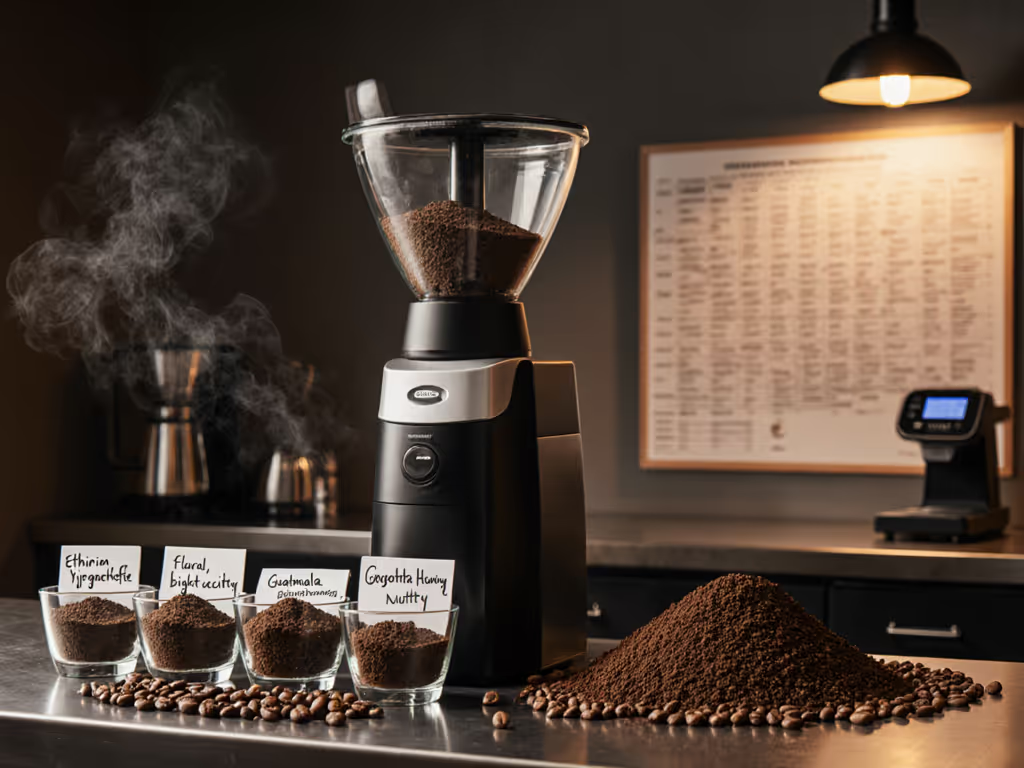
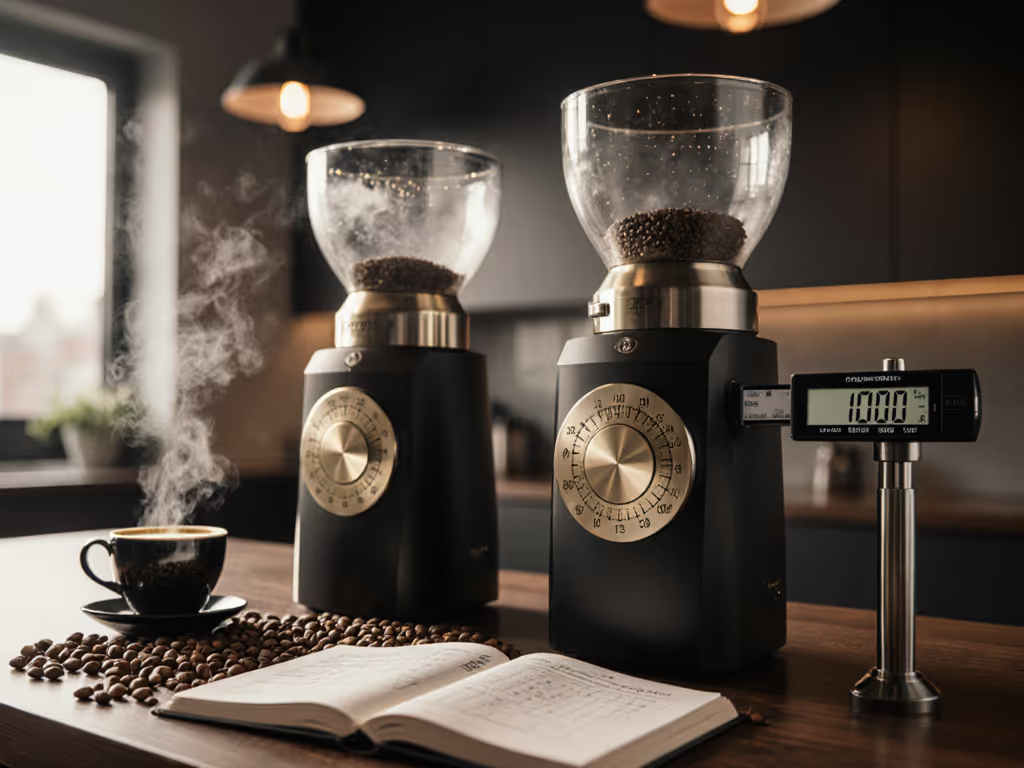
Precisely calibrated commercial coffee grinders unlock distinct origin-specific extraction, transforming subtle terroir nuances (like Ethiopian florals or Guatemalan cocoa notes) into tangible flavors. Unlike entry-level grinders, commercial-grade machines achieve particle uniformity below 200 microns, a non-negotiable for minimizing channeling in light roasts and preserving origin transparency[2][3][7]. Their burr stability combats thermal drift, which can mask delicate terroir characteristics during high-volume service[2][5]. Learn how temperature management affects consistency in our grinder temperature guide.
Why are industrial burrs non-negotiable for terroir expression?
- Particle distribution superiority: Commercial flat burrs (e.g., 80mm+ diameters) yield <15% fines deviation across batches, versus >30% in prosumer models. This narrow distribution prevents muddiness in washed African coffees where clarity defines quality[3][4][7].
- Heat management: Titanium-coated burrs dissipate grinding heat 40% faster than steel equivalents, preserving volatile aromatics in high-density Gesha varieties[2][5].
- Load tolerance: Hardened alloys maintain micron-level alignment under 50kg daily throughput, avoiding the extraction drift common in smaller burrs after 20kg[7].
How do bean density variations demand hardware adaptability?
Coffee bean density differences (e.g., 0.45g/cm³ Yemeni vs. 0.68g/cm³ Brazilian) require dynamic calibration:
| Low-Density Beans (Yemen, Ethiopia) | High-Density Beans (Colombia, Guatemala) |
|---|---|
| Require slower RPM (800-1,000) to minimize fracturing | Tolerate aggressive grinding (1,200-1,500 RPM) |
| Optimal at wider burr gaps (800-1,000µm) | Perform best at narrower gaps (500-700µm) |
| Prone to static; need ionized grind paths | Less static-prone; suit standard pathways |
Conical burr sets (like those in grinders supporting varietal grind profiles) excel here, their bimodal distribution offsetting brittleness in low-density naturals[3][4]. For systematic adjustments across roast densities, see our grind setting stability guide.
What technical specs directly impact terroir fidelity?
- Burr material: Ceramic-over-steel hybrids resist seasoning-related drift, critical for traceable coffee terroir extraction over 6+ months[4][7].
- Motor torque: >0.75 HP motors prevent RPM drop with dense beans, avoiding uneven extraction in anaerobic ferments[2][5].
- Retention systems: <0.2g exchange (via forced-air purge) eliminates stale contamination between micro-lot switches, a must for preserving specialty coffee characteristics[3][6].
Calibration protocol for origin switching
- Pre-adjustment purge: Run 5g sacrificial beans to evacuate residue.
- Macro-shift first: Coarsen by 150-200µm when moving from dense to porous beans.
- Micro-trim post-brew: Tweak in 20µm increments based on taste:
- Underdeveloped acidity → Finer
- Astringent dryness → Coarser
- Validation: Measure TDS variance ≤0.15% across 3 consecutive brews[5][8].
Alignment and drift separate toys from tools in service. Burr carriers securing <5µm wobble tolerance (verified via marker tests) prevent the muted, blended flavors plaguing poorly machined units[4][7]. This mechanical rigor enables roasters to spotlight terroir, not equipment limitations.
For cafes prioritizing adaptive precision, grinders like the Baratza Sette 270 demonstrate viable micro-adjustment (270-step) scalability for limited-batch execution without a commercial footprint. If you're weighing adjustment mechanisms, compare stepped vs stepless adjustments for precision and repeatability. Yet in high-throughput environments, uncompromising thermal and alignment stability remains the terroir interpreter's true workhorse.
Further exploration demands logging grind-response curves per origin: Plot extraction yield against particle distribution at 50µm intervals to isolate your grinder's terroir-translation bandwidth.
Related Articles