Stepless vs Stepped Adjustment: Precision Mechanics Tested
By Elena Petrescu • 19th Mar
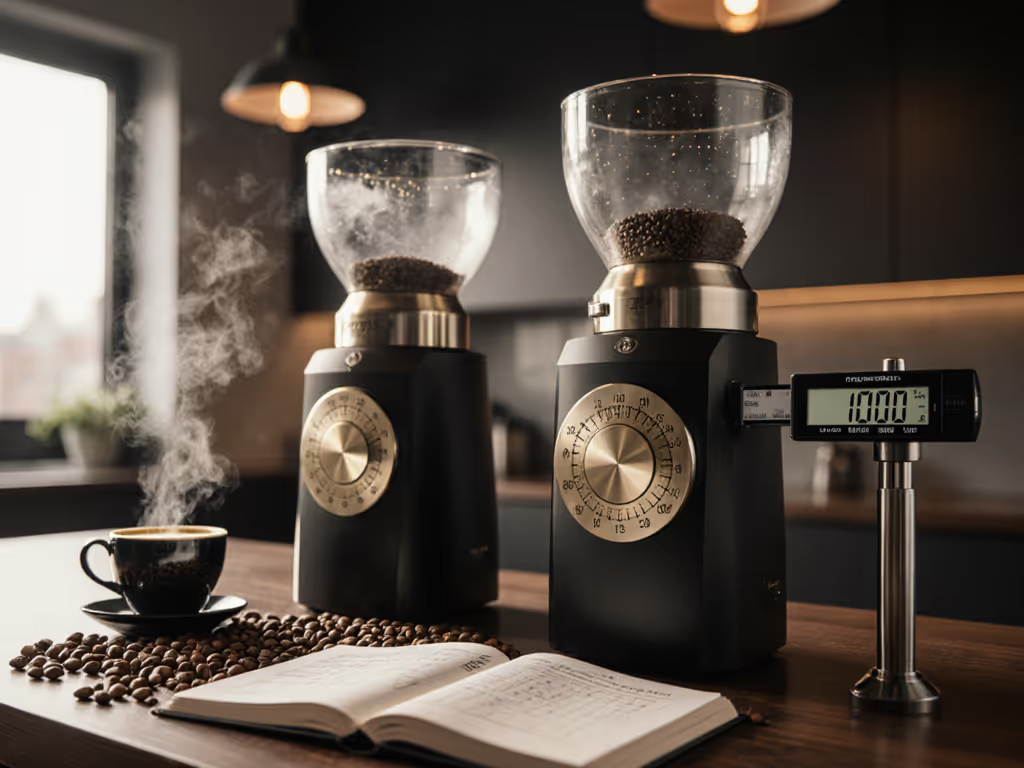
Stepless vs stepped adjustment mechanics represent the fundamental divide in how grinders translate user input into burr position, and this distinction carries measurable consequences for extraction repeatability and dial-in speed. Unlike marketing narratives that favor one system wholesale, a rigorous comparison reveals that true precision depends less on the adjustment type itself and more on how each mechanism responds to thermal drift, mechanical wear, and cumulative use (factors that separate serviceable tools from frustrating novelties). For a deep dive into managing heat-related drift, see our grinder temperature stabilization guide.
Stepped Adjustment: Fixed Settings and Mechanical Certainty
Stepped grinders operate via preset notches or clicks, typically controlled by a locking ring or collar that engages with crenelated stops. Each step corresponds to a discrete burr position. The number of steps varies widely: consumer models may offer 40-60 steps, while micro-stepped variants claim 100+ increments, reducing the gap between adjacent positions to fractions of a millimeter.
Mechanical Predictability
The core advantage of stepped adjustment lies in its repeatability. Once you identify a desired grind setting (say, 35 clicks), that reference becomes deterministic. Return to position 35, and the burrs occupy the same separation. This creates a shallow learning curve and enables rapid switching between brewing methods without extensive recalibration.
However, stepped systems impose an upper limit on granularity. If your optimal extraction sits between two mechanical steps, you cannot access it directly. For espresso, where a 0.2 mm burr gap shift can lengthen shot time by 2-3 seconds, preset steps can frustrate tuning efforts. The problem compounds when bean age, seasonal humidity, or ambient temperature shifts demand micro-adjustments that steppers cannot accommodate smoothly. For adjustment strategies across bean ages and roasts, see roast density grind settings.
Thermal Drift and Repeatability Constraints
Mechanically rigid stepped designs do hold their calibration across extended grinding sessions, provided the internal components remain aligned. Yet stepped grinders are not immune to thermal growth in the burr carriers and mounting hardware, a reality I learned during a Saturday morning service when mid-rush espresso flavor drifted, shots slowed, and acidity dulled. A purge and realignment recovered the baseline, but the session exposed a hard truth: even robust steppers can drift under load, and once they do, the reference points become less meaningful until recalibration occurs.
Stepless Adjustment: Continuous Control and Tuning Complexity
Stepless (or micrometric) adjustment employs a worm gear or smooth rotating collar that allows burr separation to move along a continuous path. This mechanism theoretically offers infinite grind positions between coarsest and finest extremes.
Extraction Yield Advantages
Stepless grinders dominate espresso workflows precisely because they eliminate the in-between problem. If a shot is running 1 second too fast, a tiny dial rotation (often sub-millimeter) tightens the burrs without locking into a coarser step. This precision (measured in microns of adjustment) translates into more consistent extraction yields and reduced channeling.
For filter brewing and pour-over, the advantage is less dramatic but still present: stepless systems permit gentle micro-adjustments that fine-tune particle distribution without jumping to a noticeably coarser or finer overall texture.
The Trade-Offs: Calibration Loss and Complexity
Stepless adjustment introduces a critical usability cost: absent fixed reference markers, returning to a previous setting requires either detailed note-taking (recording the dial angle or visual collar position) or kinetic memory. If you switch from espresso to filter and later return to espresso, locating your original dial position becomes guesswork, particularly frustrating if the optimal setting was born from 30 minutes of dialing-in and failed shots.
Moreover, stepless mechanisms place a higher burden on the operator to hold calibration across environmental changes and bean variations. Without a mechanical stop to anchor confidence, drift becomes harder to detect and easier to dismiss as normal variance.
Comparative Mechanics: Precision vs. Stability
| Feature | Stepped | Stepless |
|---|---|---|
| Adjustment granularity | Fixed; limited to preset increments (typically 0.3-1 mm gaps between steps) | Infinite; sub-millimeter adjustments possible |
| Return repeatability | High: dial position determines burr gap reliably | Moderate: requires marking or memory; drift harder to detect |
| Thermal drift tolerance | Moderate: burr carrier growth affects absolute position but not relative step logic | Lower: burr carrier growth can shift the mechanical zero, rendering dial positions unreliable |
| User skill required | Low: click and brew | Higher: demands understanding of dial feel and environmental feedback |
| Cost | Lower (simpler mechanics) | Higher (worm gear, precision tolerances) |
| Switching brew methods | Fast: reference numbers available | Slower: manual recalibration or dial notation needed |
Testing Calibration Stability Under Real Conditions
Lab data comparing stepped and stepless grinders often omit a critical variable: how each adjustment mechanism responds to thermal cycling and accumulated grinding volume. Extraction yield data (reported as percentage of solubles extracted) can mask mechanical instability if measurements are taken in controlled conditions rather than across multi-hour service windows.
A rigorous test protocol includes:
- Baseline setup: Dial in a target shot time (e.g., 25-30 seconds for espresso) at ambient temperature.
- Thermal stress: Grind continuously for 60-90 minutes (simulating service), then return to the original dial position without adjustment.
- Repeatability check: Pull shots at the original dial setting and measure shot time and extraction yield. Deviations >2 seconds or >2% yield variance indicate calibration drift.
- Bean variability: Repeat the test with beans 2-3 weeks older (lower density, drier) and measure required dial adjustments to maintain target shot time. Smaller adjustments indicate greater stability.
Stepless grinders often require larger dial rotations to compensate for bean age, reflecting the absence of mechanical anchoring. To minimize waste while finding new positions, follow our step-by-step dial-in guide. Micro-stepped designs (with 100+ steps) narrow this gap but do not eliminate it.
Alignment and Drift: Separating Tools from Novelties
The decisive factor in choosing between stepped and stepless adjustment is not granularity alone but alignment and drift. Learn how wear evolves and when to replace parts in our guide to burr wear and extraction stability. Grinders with poor burr carrier rigidity, backlash in the adjustment threads, or internal thermal gradients will frustrate both stepped and stepless workflows. A stepless grinder with sloppy bearings offers infinite positions but no confidence; a stepped grinder with rigid construction holds calibration across shifts.
Alignment and drift separate toys from tools in service, and this principle applies equally to both adjustment types. A micro-stepped grinder with tight tolerances and a thermally stable housing will outperform a loose stepless competitor; conversely, a well-engineered stepless design with precise worm gearing and minimal backlash will yield faster dial-in cycles than a coarse-stepped grinder with play in the locking ring.
Practical Guidance for Dial-In Repeatability
- Stepless adjustment favors single-origin, single-bean focus: If you grind the same bean daily, stepless systems reward the time invested in finding and marking the optimal dial position. Extraction consistency improves once that baseline is locked into muscle memory.
- Micro-stepped adjustment (40+ steps per millimeter) minimizes practical difference: At 0.1 mm per step, the functional gap between stepped and stepless narrows significantly. Many users report no perceptible limitation.
- Thermal stability matters more than step count: A grinder that drifts 0.5 mm over 2 hours of service defeats the precision advantage of stepless adjustment. Verify thermal performance before prioritizing granularity.
The Case for Mechanical Rigidity Over Adjustment Type
When evaluating a grinder's precision mechanics, interrogate the burr carrier design, bearing quality, and materials that resist thermal growth. Stepped or stepless becomes secondary to whether the mechanism can hold calibration across heat, volume, and frequent bean changes, the ultimate test of a tool designed for repeatability rather than novelty.
Neither adjustment type is intrinsically superior. The choice depends on your workflow (single bean vs. frequent switching), tolerance for dial-in overhead, and the grinder's underlying mechanical stiffness. A rigid stepped grinder will serve longer than a loose stepless one; precision matters less than stability when your target is repeatable extraction.
Further Exploration
Deepen your investigation by measuring grinder thermal drift over a 90-minute service window using shot time and extraction yield as proxies. Test both adjustment types under identical bean age and ambient conditions. Document which mechanism requires fewer dial adjustments to maintain consistency, a practical metric often omitted from manufacturer specs but vital to real-world performance. Cross-reference burr carrier materials, bearing preload specifications, and user reports of alignment issues to identify grinders engineered for long-term calibration stability rather than feature breadth.
Related Articles